Professional video editing has always been a balance between two very different kinds of work. There’s the craft: the judgement calls about story, rhythm, and feel. And there’s the execution: the hours spent organising footage, syncing audio, smoothing out inconsistencies, and preparing versions for different platforms. Both matter, but only one of them actually needs an editor’s eye.
AI is starting to change that balance. Rather than replacing editors, it’s becoming a creative assistant that absorbs the repetitive parts of the job, reviewing footage, cleaning up audio, generating captions, and building alternate cuts, while leaving the creative decisions where they belong: with the editor.
The shift isn’t just about speed. The more interesting development is AI that understands why a change is needed and how it fits the larger creative vision, rather than just executing isolated commands.
A single professional edit is made up of hundreds of small decisions and manual actions: finding the right moments across hours of footage, organising clips, syncing audio and video, trimming pauses, building alternate cuts for different platforms, adjusting formats for social and broadcast, keeping scenes visually consistent, and revising based on feedback.
None of these tasks is hard to justify on its own. But multiply them across a feature film, an ad campaign, or a multi-episode series, and they start eating into the time editors would otherwise spend on the work that actually needs their judgement. Editors often end up managing timelines more than they experiment with creative choices. AI’s real value is in shifting that balance back: automating the repetitive processes while keeping humans in charge of the final call.
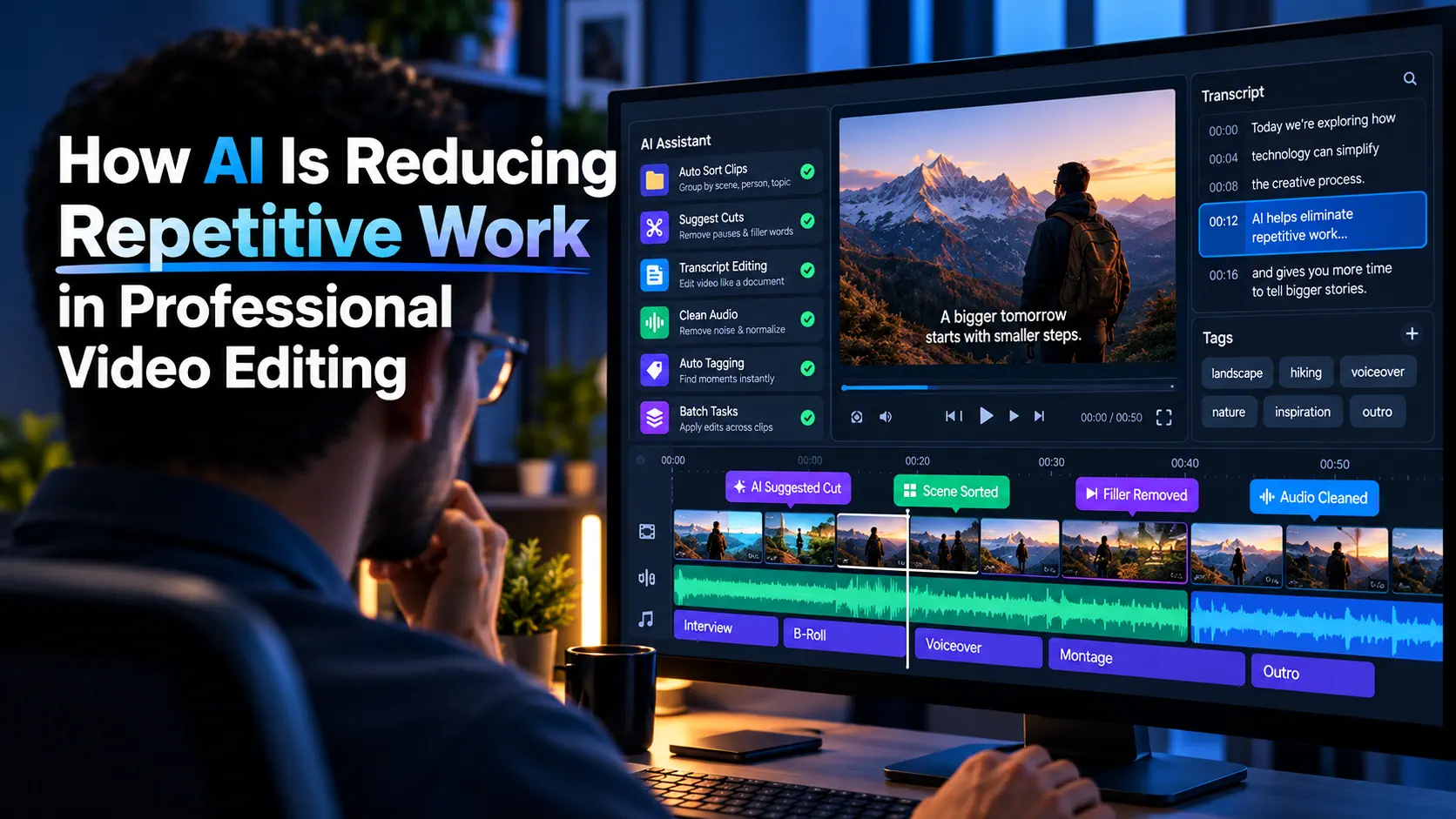
The earliest stage of an edit is usually the most tedious: reviewing raw footage, identifying usable shots, and building an initial sequence from scratch. AI can now take a first pass at this, turning an empty timeline into a structured starting point: clips organised by scene or purpose, key moments flagged, rough sequences assembled, gaps in coverage surfaced, and initial edits ready for review.
That means less time spent searching through footage and more time spent shaping the story. The more advanced systems are moving past clip-level analysis toward understanding how shots, scenes, and characters relate to one another, a kind of semantic understanding that matters most on complex, narrative-driven projects.
Some editing tasks demand precision but not creative interpretation, which makes them ideal candidates for AI to handle.
Interview, podcast, and dialogue-heavy projects often require hours of manually trimming pauses, filler words, dead air, and repeated lines. AI can flag all of it automatically, leaving the editor to review the suggested cuts rather than hunt for them.
Fixing inconsistent audio, cutting background noise, and balancing dialogue against music is repetitive, technical work. AI tools can isolate voices, reduce unwanted noise, and improve clarity and balance, freeing the editor to focus on sound design decisions instead of routine correction.
Generating transcripts and captions by hand is another tedious step, especially for social and marketing content. AI can produce them automatically, while editors keep control over timing, style, and placement.
Very few projects end with a single final file. A single campaign might need a widescreen cut for YouTube, a vertical version for social, short clips for ads, and regional or brand variations on top of all that. Building each of these manually means hours of resizing, restructuring, and rechecking.
AI can help adapt a single edit across formats while preserving what matters creatively. Automatic reframing, for instance, can keep the important subject in frame when converting between aspect ratios. This doesn’t take the editor out of the loop; it just means more time reviewing and refining several directions instead of building each one from zero.
Consistency is one of the harder problems in professional production. A character’s look, a location’s lighting, a project’s visual language: all of it needs to hold together across scenes, sometimes across an entire series.
AI systems designed for creative workflows are increasingly built around persistent project context, rather than treating every session as a blank slate. They can retain information about characters, visual references, established creative rules, prior decisions, and overall project structure. It mirrors how a real production team operates. A director doesn’t re-explain the whole film every morning; the crew already understands the direction that’s been set.
Traditional editing means manually adjusting every clip, transition, audio level, and timeline element by hand. AI introduces a different mode of working: describing the outcome you want instead of performing every step yourself.
“Create a shorter version focused on the emotional moments.” “Make this sequence faster-paced.” “Create three alternate openings.” “Replace this shot but keep the same tone.” The system interprets the instruction and makes the change directly on a timeline that stays fully editable.
Invideo Editor is built around exactly this idea. It’s a free to sign up, browser-based, multiplayer agentic video editor where editors, collaborators, and AI agents work inside the same project. Upload your footage, add a script or transcript if you have one, and describe the base cut you want by topic, story, shooting order, or transcript. The agent reviews the material, picks the usable takes, clears out repeats and false starts, and assembles the result directly onto an editable timeline. It handles single-camera footage with or without a script, multicam projects, music- or beat-led edits, and generated media, and it can also take on silence and filler removal, chapter markers, semantic search across footage, and swapping one take for another. Every change stays visible, and every decision can be redirected or refined by hand. The agent takes the repetitive execution, but the project and every change to it stay yours.
As the repetitive work gets automated, the editor’s role narrows toward what actually requires a person: knowing when a scene feels emotionally right, understanding pacing and rhythm, picking the strongest performance, building tension and release, and shaping a coherent visual language. AI can accelerate the execution, but the judgement behind a good cut still has to come from a person with taste and a point of view.
It’s a similar structure to how film crews already operate: specialists handle different parts of production while a director holds the overall vision. AI editing tools are converging on the same model: intelligent systems handle the specialised, repetitive tasks, and the creator stays in charge of the result.
The future of editing isn’t a contest between humans and machines. It’s the two working alongside each other. The next generation of tools should help editors explore more creative options, test alternate cuts faster, hold continuity across large projects, collaborate across teams more smoothly, and spend less time managing timelines by hand. Projects that once needed large teams and long production cycles become more manageable without asking anyone to lower their creative ambitions.
AI isn’t removing the craft from editing; it’s removing the friction around it. What’s left is a workflow where technology absorbs the repetitive operations and editors spend more of their time doing the part of the job only they can do: shaping the story. Invideo Editor is one expression of that shift: human editors, creative teams, and AI agents working inside the same editable timeline, combining manual control with intelligent assistance.
Professional video editing has always required both creativity and repetition. What AI is doing is pulling those two apart: automating the time-consuming parts while leaving creative control firmly in human hands. From organising footage and cleaning audio to generating platform versions and executing timeline changes on instruction, AI is becoming a genuine partner for editors rather than a replacement for them.
The editor of the future won’t be someone who creates less. They’ll be someone who spends less time on repetitive work and more time making the decisions that actually matter.
 u
u